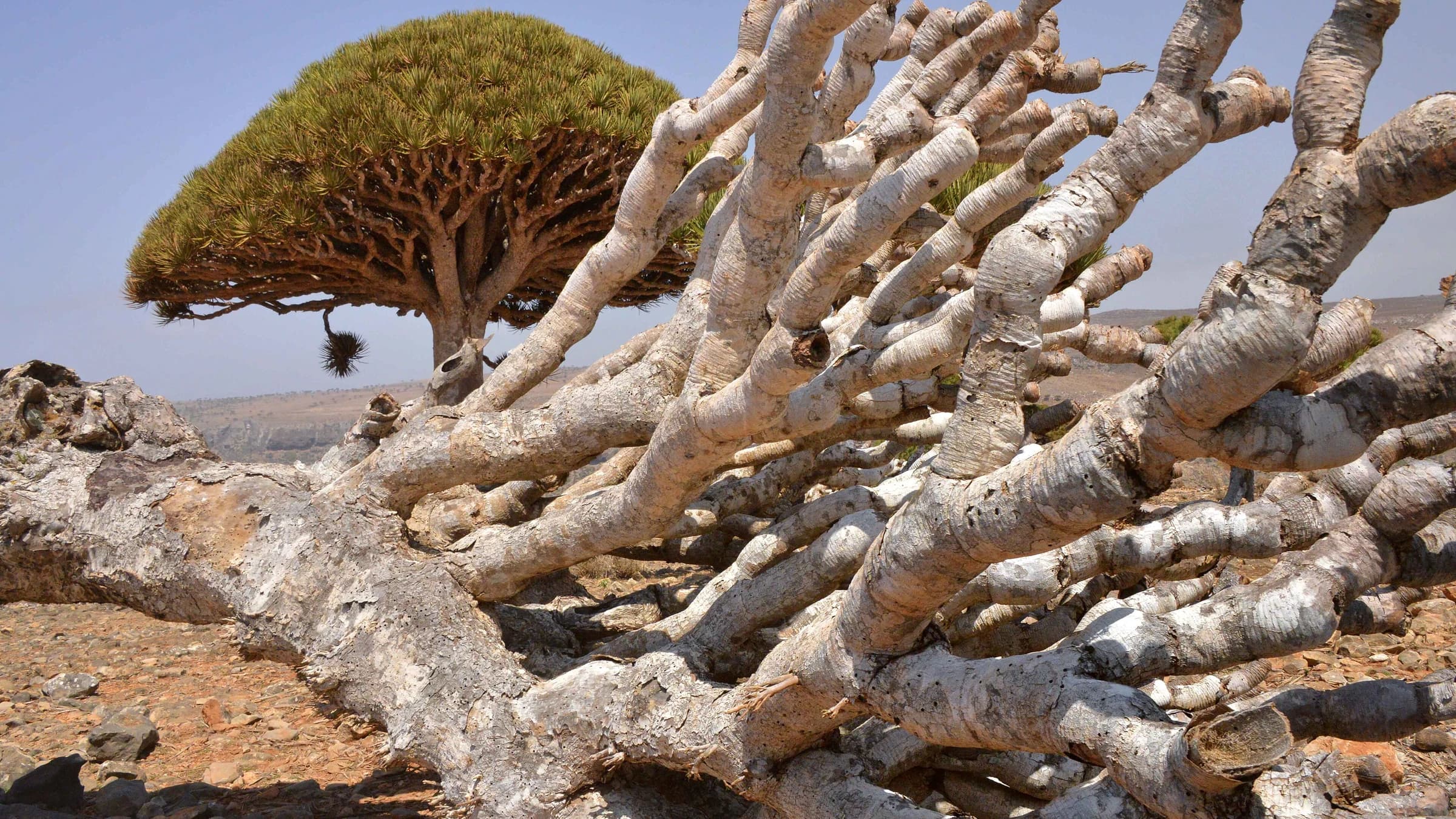
A February-to-March trip built around one thing: the dragon's blood trees in flower, in months that are calm on the plateaus and cool enough to walk all day. Nine days, dedicated photographic slots rather than drive-by stops, and two nights at Firmihin so the forest gets first light and last light rather than the middle of the day.
This is the shoulder of the season, which the generic circuit sells badly and which is arguably the better time to come.
A note on the length. The Jeddah rotation is the constraint that sets every Socotra itinerary, and sources disagree about whether it currently runs once or twice a week. Eight days always works. Any other length depends on the rotation in your specific window, so we confirm it against live schedules and tell you in writing before you commit to anything. If it will not work for your dates we will say so rather than sell you a trip that has to be rebuilt.
What it costs
- Land only
- $2,516
- All-in
- $3,516
Everything on the island, per person.
Land plus the return Jeddah–Socotra flight.
These are real numbers, not a “from” price, and they are indicative until we confirm them against live availability for your dates — the flight rotation and the permit both move. You get a firm figure in writing before you commit to anything. Why the same trip is quoted so differently across the market is covered in what Socotra actually costs.
Socotra is a cash-USD island: no working ATMs, no card acceptance. Bring $500–800 in small denominations, and note that only crisp notes from 2009, 2013 or 2017 onwards are reliably accepted.
Day by day
Pattern A, weighted to the forest and the plateaus
We do not print driving times. Almost none are published by anyone and the two figures that circulate could not be attributed to a source, so we would rather leave them out than invent them. Walking times below are the ones operators publish.
- Day 1
Arrive
NorthAirport, Wadi Ayhaft for the first dragon trees and a freshwater pool, and down to the coast.
Overnight: Delisha Beach camp
- Day 2
Dihamri
North-eastThe reef, and the calmest months of the year for getting into the water. Late afternoon in the fishing village.
Overnight: Dihamri camp
- Day 3
Hoq and the dunes
EastThe cave walk, roughly three hours round trip as operators publish it, then Arher at sunset — the dunes photograph best in the low, hard light of these months.
Overnight: Arher Beach camp
- Day 4
Homhil
East and plateau edgeThe one place on the island where bottle trees, frankincense and dragon's blood grow together, with the resin harvest if the family is working. A dedicated slot at the infinity pool rather than twenty minutes.
Overnight: Homhil camp
- Day 5
Zahek at dawn
SouthAcross to the south coast, and the white dunes at Zahek at first light — the shot that is usually taken at midday because of how the standard circuit is routed.
Overnight: Amak Beach camp
- Day 6–7
Two nights at Firmihin
CentreThe heart of the trip. Diksam and the Wadi Dirhur canyon, then two nights in the forest: sunrise, dusk, and the crowns against the Milky Way. The dragon-blood nursery on Diksam, where seedlings are raised under protection because the wild population is not regenerating — the flowering you have come to photograph is not producing a next generation, and that is the story.
Overnight: 2 nights, Firmihin camp
- Day 8
Shuab and Detwah
WestQalansiyah and the boat along the cliffs to Shuab, then Detwah for the last night on the lagoon.
Overnight: Detwah Lagoon camp
- Day 9
Out
—Airport, three hours ahead.
What is included
- Return flight Jeddah–Socotra
- All airport transfers on Socotra
- 4x4 with driver throughout
- English-speaking Socotri guide, plus local site guides for the cave, the canyon and the forest
- All meals, snacks and drinking water from the crew kitchen
- Entry fees for every protected area on the route
- The boat to Shuab
- Camping equipment: tent, mattress, bedding, camp furniture and lighting
- One hotel night in Hadibo
- Dedicated first-light and last-light slots at Firmihin, Homhil and Zahek
What is not
- International flights to and from Jeddah
- The Socotra permit, which we arrange and invoice at cost — published figures run $75–200 and no authoritative number exists
- Travel insurance, which needs a specialist policy (see our insurance guide)
- Tips for the crew
- Personal spending, and anything you buy on the island — bring cash in USD
- Drone permit, if you are bringing one
This suits you if
- · Photographers
- · Anyone interested in the botany rather than the beaches
- · Travellers who want the calmest wind months
- · People who would rather wait for light than tick sites
Pick something else if
- · Anyone who cannot travel in February or March
- · Travellers who want maximum site coverage
- · Anyone expecting guaranteed aerial photography — see the drone question
If the flight does not come
If the flight does not come. In January 2026 roughly 600 travellers sat on Socotra for about a week when the rotation stopped. It is the clearest risk on the trip, and the written terms across this market are all over the place: one operator charges $100 per person per day and says plainly that no cash refund will ever be issued for a cancelled flight, offering only non-transferable credit; another promises a full deposit refund; two put every extra night entirely on the traveller; one is silent on force majeure altogether. Travellers who were caught in January 2026 have publicly described recovering money by bank chargeback after being ignored, and being billed with no cost breakdown. Ours: if the return flight is cancelled, we keep the ground arrangement running — accommodation, food, vehicle and guide — and we bill extra nights at cost, itemised, with no margin added. We will send you that in writing before you pay anything. Ask any operator you are comparing us with for the same, and treat a vague answer as an answer.
More on the risk in is Socotra safe and insurance and health.
Frequently asked questions
When do the dragon's blood trees actually flower?
February and March are the sourced flowering window, and this trip only runs in it. On wind they are calm but not the calmest — the climate record puts February at 11.3 mph and March at 8.7, against April's 7.0, which is the quietest month of the year. The windier season does not start until 30 May. So February and March buy you the flowering; April buys you the best sea.
Can I fly a drone for aerials?
We will not promise it. Sources on Socotra's drone rules conflict outright — one traveller reports no restriction, another prices a permit at $100–150 — and we would rather establish the position for your dates than sell you a photography trip on a policy we cannot verify.
Why nine days rather than eight?
To get two nights at Firmihin without losing the west coast. It does depend on the flight rotation in your window, which we confirm in writing before you commit; if it will not work for your dates we will tell you and rebuild the trip around eight.
Do I need to be a serious photographer?
No. The difference is the schedule, not the gear: the trip is routed so the good places happen at the good hours. If you are shooting on a phone you will still get better pictures than the standard circuit allows.
How many people?
Eight maximum. On a photography-weighted trip a smaller group is not a luxury — it is the difference between waiting for light and waiting for people.
Is February cold?
Not on the coast. The plateaus are cooler after dark and can be windy, and two nights at Firmihin means you will notice it, so bring a fleece and a windproof layer.
What happens if the flight is cancelled?
The ground arrangement keeps running and extra nights are billed at cost, itemised, with no margin, confirmed in writing before you pay.
Ask about this trip
Socotra seats are not sold online by anyone — they are released to licensed operators, and the permit is sponsored, so every booking here starts as a conversation. Tell us your dates and we will come back with what is actually available and a firm price in writing.
Message us on WhatsAppPrefer to read first? How booking Socotra actually works