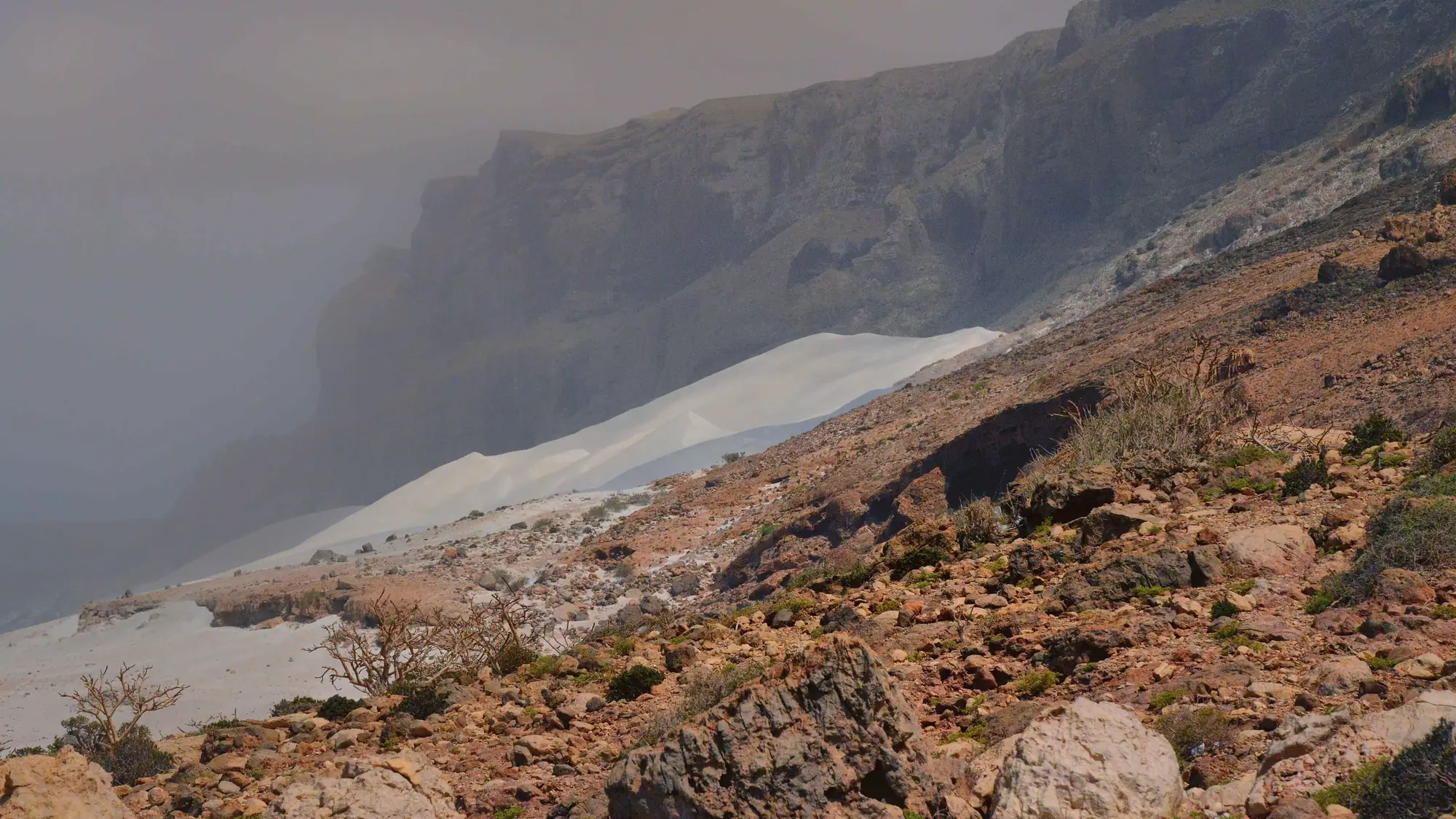
 Rod Waddington from Kergunyah, Australia · CC BY-SA 2.0
When to Visit Socotra: The Season, Month by Month
The season runs roughly October to April. From around May or June to September the southwest monsoon, the khareef, brings winds that make camping impractical and flights unreliable, and operators do not run trips. Within the season, the midwinter months are the most comfortable for camping, and February to March is the window most often given for the dragon's blood trees to flower.
Socotra is not a destination you visit whenever you have leave. It is open for about seven months and shut for the rest, and the closure is not a matter of comfort.
The khareef
From roughly May or June to September, the southwest monsoon crosses the island. Locally it is the khareef, and it brings sustained winds that make tents impractical, close the boat crossings that several sites depend on, and make the flight unreliable.
Operators do not run trips in this window. That is the practical definition of closed: not that the island is unreachable in theory, but that the machinery which makes a visit possible stops.
So the season is October to April, and everything else about timing sits inside that.
The flight decides more than the weather
Here is the thing most seasonal guides miss. On Socotra the binding constraint is not the temperature, it is the rotation.
The flight runs about once a week in season. That is why nearly every itinerary you will see is eight days and seven nights: you arrive on one flight and leave on the next. Trips of other lengths exist but they depend on a second weekly rotation that sources genuinely disagree about, so treat them as conditional until an operator confirms the schedule in writing.
What this means in practice is that your dates are chosen for you within about a week either way. Decide which part of the season you want and then take the rotation that lands nearest.
Month by month
Show the figures as a table
| Month | Season | Daytime high | Sea | Wind | What to expect |
|---|---|---|---|---|---|
| January | Good | 27 °C | 26 °C | 23 km/h | Trees are in leaf and it is good walking weather. North-east winds can make the sea rougher. |
| February | Best | 29 °C | 26 °C | 18 km/h | Dragon's blood trees and bottle trees flower. The busiest month. |
| March | Best | 30 °C | 27 °C | 14 km/h | Calm seas and clear water. Often named the best month for diving. |
| April | Good | 32 °C | 29 °C | 11 km/h | The lowest average wind of the year: calm seas and warm water. |
| May | Shoulder | 33 °C | 30 °C | 20 km/h | The hottest month and the warmest sea. The wind builds from mid-month. |
| June | Closed | 32 °C | 28 °C | 40 km/h | The south-west monsoon starts, and trips stop. |
| July | Closed | 30 °C | 25 °C | 47 km/h | The height of the monsoon, and the windiest month. |
| August | Closed | 29 °C | 24 °C | 43 km/h | Still monsoon. The sea is at its coldest. |
| September | Shoulder | 30 °C | 25 °C | 29 km/h | The monsoon eases. Sources disagree on whether it is worth travelling. |
| October | Good | 31 °C | 27 °C | 15 km/h | The season opens. A good month for diving. |
| November | Good | 30 °C | 27 °C | 20 km/h | Short, heavy storms can flood the wadis, so camps are chosen with care. The 2015 cyclones struck in November. |
| December | Good | 28 °C | 26 °C | 24 km/h | Good trekking weather. New Year trips fill early. |
October opens the season. The monsoon is clearing and conditions can still be unsettled early in the month, so the back half is the safer bet. The island is green from the summer winds in a way it will not be later, the sites are quiet, and prices are often softer.
November and December are the reliable heart of the early season, with comfortable daytime temperatures and cool nights on the plateaus. November can bring short, heavy storms that flood the wadis, and in December north-east winds can make the sea rougher and limit diving. The weeks around New Year are in high demand and book out first.
January is the coolest month and the most comfortable for camping. Nights on the high ground at Firmihin and Diksam are genuinely cold by island standards, which is worth a warm layer. This is also the month in which, in 2026, the airport closed and several hundred visitors were stranded for about a week, which is not a seasonal pattern but is a reminder to keep a buffer on the way home.
February and March are the months most people would pick. Warm days, comfortable nights, and the window most often given for the flowering of the endemic flora, including the dragon's blood trees. If botany is why you are coming, this is the target, with the caveat that flowering varies year to year and nobody can promise it.
April closes the season and heat becomes the deciding factor. Early April is still comfortable. By late April the middle of the day starts limiting what is worth doing — but the constraint is heat, not wind, and that distinction matters more than it sounds. Quiet, cheap, and hot.
Choosing by what you want
For comfort while camping, take December through February. Cool nights, settled days.
For the flowering and the endemic flora, February into March, and say so when you enquire so the itinerary weights the plateau days.
For the sea, March and April, when the wind is at its lowest. Boat trips to Shuab and the snorkelling at Dihamri are the first things a swell takes away, and both sit at the heart of the coastal itineraries.
For quiet and lower prices, the shoulders: late October, or April.
The April misconception
April is, on the climate record, the calmest month of the year on Socotra — averaging 7.0 mph, against 28.8 mph in July. The windier season does not begin until 30 May. So the sea in April is the best sea you will get: the boat to Shuab, the Detwah crossing and the snorkelling at Dihamri are all at their seasonal best, and several operators independently name February to April as the optimum window for exactly those things. November and December seas are rougher and more likely to stop the Shuab boat than April is.
Operators saying "the monsoon begins in May" are describing when their season ends, not the weather. Read as a wind warning it points you away from the best boat month of the year.
What genuinely degrades in late April is land: around 32°C by day, humidity rated very high, and almost every day muggy. The mountains stay materially cooler. Late April is excellent at sea and demanding on foot, so put Hoq Cave and the long inland walks in the early morning and give the middle of the day to the water. Fewer people at the same sites.
For photography, February and March combine flowering with the clearest skies, though the shoulder months often give better light and emptier foregrounds.
Booking lead time
Book earlier than instinct suggests.
Seats are not sold online. They are released to licensed local operators, and capacity on each rotation is small. On top of that, the permit is sponsored by your operator and needs roughly three weeks of lead time before travel.
For the popular weeks, particularly around the winter holidays and the February to March flowering window, several months of notice is normal rather than cautious.
What the season does not fix
Two things stay true regardless of when you go.
The flight remains a single point of failure. A weekly rotation means any disruption costs days. Leave a buffer between your return and any onward international connection, in every month.
And the practical realities of the island do not soften in high season: still no ATMs, still no card acceptance, still cash in clean US dollars, still camping for most of the trip. Those are covered in camping on Socotra, and the wider safety and insurance picture in is Socotra safe.
For what the trips themselves look like across the season, see our expedition packages.
Why the island is green in October and brown in April
The monsoon that closes Socotra is also what feeds it.
Through the khareef, the southwest winds drive moisture across the island. Very little of it falls as conventional rain on the lowlands, but the highlands intercept it as cloud and mist, and that is what the vegetation lives on. The dragon's blood tree's whole architecture, that flat crown of densely packed branches, exists to comb water out of moving cloud.
So the season you visit in runs downhill from that. October follows the wet months and the interior still shows it. By April the island has been drying for six months, the wadis have thinned, and the greens have gone to ochre and grey.
Neither is better. October is lush and the light is often soft. April is stark, the colours are hotter, and the geology reads more clearly because there is less growing on top of it. Photographers tend to have strong opinions in both directions.
The pools, and when they hold water
A practical consequence worth planning around: the freshwater pools that make the canyons worth the walk are seasonal.
Kalysan, Ayhaft and the pools below the Diksam plateau are reliably full early in the season and drop through it. By late in the season some are reduced to shallow standing water. If swimming in a canyon is on your list rather than a bonus, weight your dates towards the first half.
The same applies to the waterfall at Ayhaft, which is a feature in November and often a damp rock face in April.
Temperature, roughly
Nobody publishes a reliable per-month table for the island specifically, and the figures you will find are usually mainland Yemeni data or modelled estimates rather than measurements on Socotra. Treat any precise table with suspicion, including ones that look authoritative.
What is consistent across sources: the coast is warm all season and hot at the end of it. The interior is several degrees cooler and noticeably cold at night in midwinter. The wind on the plateaus is close to constant, which makes the same air temperature feel very different at Firmihin than it does at Detwah.
Pack for both. Most people underpack the warm layer because they are picturing an island in the Arabian Sea and not a plateau at altitude on it.
Chat with a real person — free
Seif and the team reply on WhatsApp — trip questions, custom plans and booking help.
Ask Seif on WhatsAppCommon questions
When is the best time to visit Socotra?
The season runs roughly October to April. Within it, the midwinter months are the most comfortable for camping, and February to March is the window most often given for flowering. The island is effectively closed from around May or June to September.
Why does Socotra close in summer?
The southwest monsoon, known locally as the khareef, brings sustained winds strong enough to make camping impractical and flights unreliable. It runs from roughly May or June through September. This is a hard constraint rather than a preference.
Can I visit in summer anyway?
In practice, no. Operators do not run trips, flights become unreliable, and the sea state closes the boat trips that several sites depend on. If someone offers you a July departure, ask a great many questions.
When do the dragon's blood trees flower?
February and March are most commonly given, and it varies year to year. If flowering is the point of your trip, ask your operator what they are actually seeing on the ground before fixing dates.
How hot does it get?
The coast is warm year-round and gets hot late in the season. The interior plateaus are meaningfully cooler, particularly at night, and windy. Late April is the point at which daytime heat starts limiting midday activity.
Does the flight schedule affect when I can go?
More than the weather does. The flight runs roughly weekly in season, which is why almost every trip is eight days: one flight in, the next flight out. Your dates are shaped by the rotation, not by your preference.
When should I book?
Early. Seats are released to licensed operators rather than sold online, capacity per rotation is small, and the permit needs roughly three weeks of lead time. Peak weeks around the winter holidays go first.
Is the shoulder season worth it?
October and April are quieter and the light is often better. October carries some residual risk of unsettled conditions as the monsoon clears, and late April brings heat. Both are legitimate choices if you would rather not share the sites.
Keep reading
Socotra Permit and Entry, 2026–27: It Is Not a Yemen Visa
Every Socotra trip runs on a permit your operator arranges, while governments describe a different document altogether. What the permit is, what it costs, who issues it, and the distinction almost nobody writes down.
By TiS Authors8 min read
Travel Insurance and Health for Socotra: What Is Actually Covered
One widely recommended policy names Yemen on its excluded list. No medical evacuation from Socotra is documented as ever having happened. What we could verify, and what nobody publishes.
By TiS Authors10 min read
Is Socotra Safe in 2026? The Honest Answer, With Sources
Socotra is part of Yemen, and every Western government advises against travelling there. What that actually means, what the real risks are, and the two consequences almost nobody tells you about.
By TiS Authors10 min read