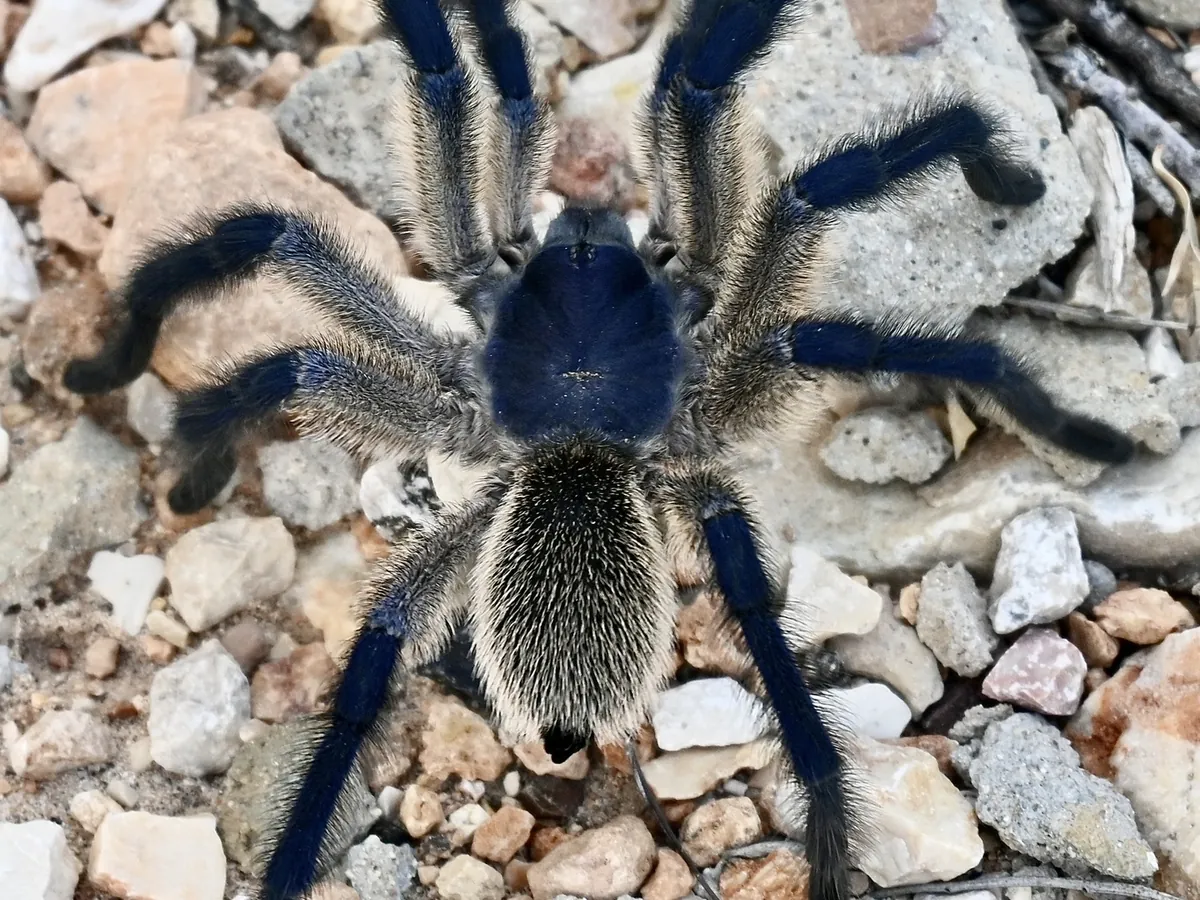
Socotra's most widely known animal is not a bird or a reptile. It is a spider, and most of the people who know it have never been near the island.
Monocentropus balfouri is a staple of the tarantula-keeping hobby, bred in captivity across Europe, North America and East Asia. It is also, according to the researchers who work on the island, heavily exported from Socotra illegally to supply that trade.
What it is
A tarantula found only on the Socotra archipelago. Adults carry the blue that gives the species its name, strongest on the legs and carapace, over a pale-haired abdomen.
It lives in burrows rather than in the open, and females guard their young — behaviour that is unusual enough among tarantulas to be part of why keepers want the species.
Why keepers know it and travellers don't
The spider is nocturnal and spends its time underground. A week on Socotra following the standard route will almost certainly not produce one, and no itinerary we know of offers to find you one.
So the species has an odd double life: famous in one community that mostly meets it in a plastic enclosure in another country, close to invisible to the people who travel to where it actually lives.
The 2024 bite report
Until recently there was no detailed medical account of what this spider's venom does to a person. In 2024, Wu and colleagues published one in The Journal of Emergency Medicine (66(4), 467–469): the owner of an exotic pet shop in China was bitten while handling one.
The symptoms recorded were numbness around the mouth, intense muscle cramps, rapid breakdown of muscle tissue and general weakness. Benzodiazepines relieved the symptoms and the patient recovered.
Two things are worth keeping straight. The species is not described as aggressive, and the case happened in a shop, not in the field. The report's own conclusion was about conservation rather than danger: endemic spiders should not be moving through the pet trade in the first place.
The smuggling is the real story
The same literature that documents the bite documents the route it took to get there. Socotran endemics leave the island for collectors, against Yemeni law.
It is not only spiders. Researchers list excessive collection of the Socotra brown skink "for tourist tips" among the threats to that species — prohibited, and observed anyway.
The practical version: do not pay anyone to produce an animal for you. A guide who digs out a burrow or catches a skink for a photograph is responding to a demand that visitors create.
Where it sits among Socotra's invertebrates
The island's invertebrates are the least-visited part of its biology and, by the numbers, among the most remarkable. Bezděk and Hájek recorded 1,564 insect species on the archipelago, 42 per cent of them endemic, with 62 endemic genera.
UNESCO's listing puts the sharpest figure on land snails: 96 species, 95 per cent of them endemic — the highest rate of any group documented on the island.
What else is down there
The ground and the trees around a burrow hold more endemic life than the burrow does. Twelve endemic reptile species live on dragon's blood trees, among them geckos with ranges as small as ten square kilometres.
The archipelago has exactly one chameleon, Chamaeleo monachus, and it is endemic. The Socotra brown skink, Trachylepis socotranus, is the one visitors most often see, and the one most often picked up.
None of this is on the standard itinerary either, which is part of why the island's reptiles and invertebrates are so thinly documented compared with its plants and birds.
Will you see one?
Probably not, and we would rather say so than sell the idea. If you are on the island at night, near rocky ground, the burrows are what to look for rather than the spider.
Leave the burrow alone. The population is under pressure from collection already, and a dug-out spider is a spider that will be collected again.