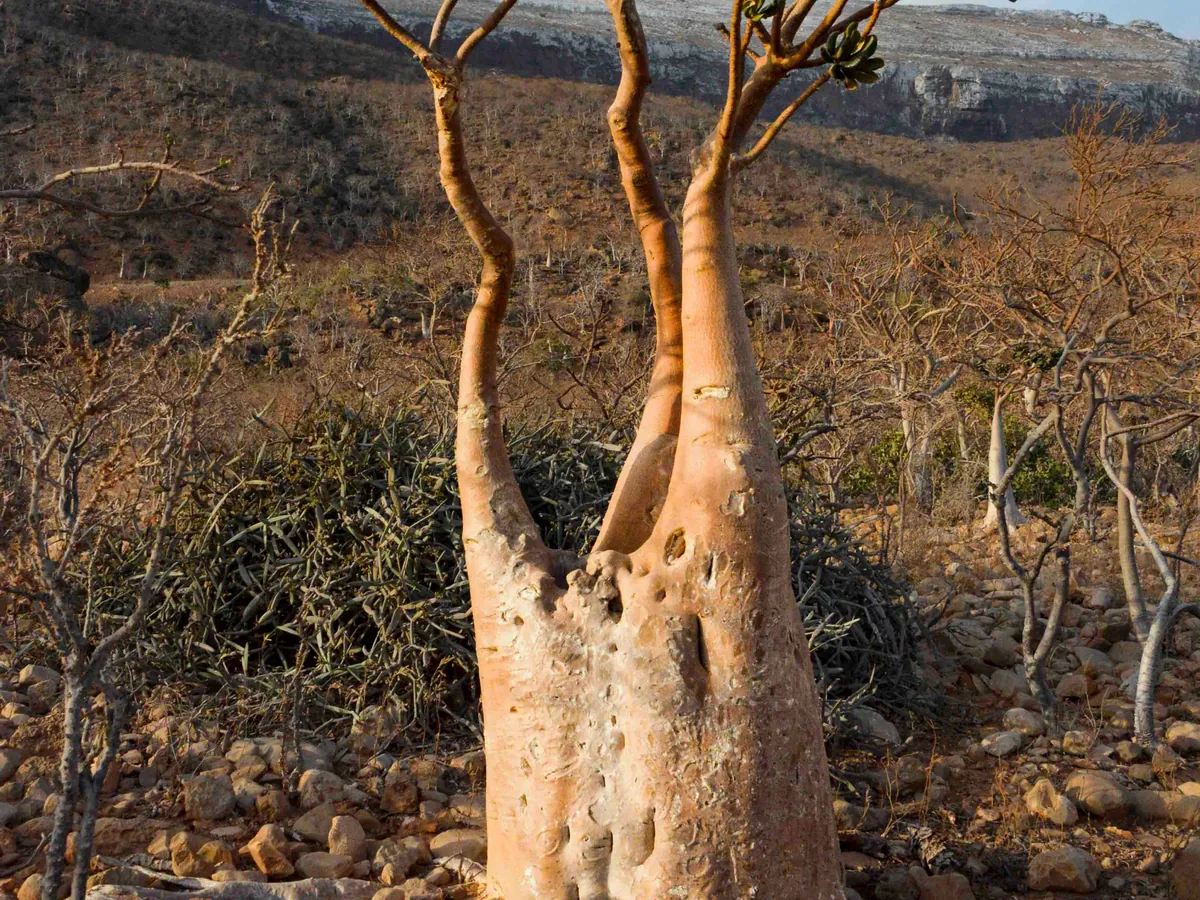
Every photograph of Socotra leads with the dragon's blood tree. The bottle tree is the one in the second frame: a swollen trunk the colour of raw pastry, standing on rock with almost no soil under it, usually bare, and for a few weeks each year covered in pink flowers.
It is not a separate species. Botanists treat it as an endemic subspecies of Adenium obesum, the desert rose that grows across the Sahel and southern Arabia. The Socotran form is the one that grows into a tree.
Why the trunk is that shape
The trunk is a water tank. Rain on Socotra arrives in a short season and then stops, and these trees are usually rooted in cracked limestone rather than soil, so the plant carries its own supply through the dry months. That is where the English name comes from.
It also explains why the tree looks wrong for its setting. A bottle tree in December can be leafless, grey-pink and apparently dead, standing on rubble in full sun, and be in perfect health.
When it flowers
February and March are the months sources consistently give for full flowering, which is also when the dragon's blood trees flower. That timing sits at the back end of the October-to-April season, so a trip built around the flowers is a late-season trip.
Come in October or November and you will mostly be photographing trunks. That is not a wasted journey — the shapes are the reason the tree is famous — but it is worth knowing before you book a date for the flowers.
Where you will see it
Homhil is the reliable one. The protected area holds bottle trees, frankincense and dragon's blood trees on the same slope, which is why nearly every itinerary that visits Homhil returns with the same photograph of all three.
Bottle trees grow elsewhere on the island too, on rocky ground at a range of altitudes. We do not publish a distribution map, because we have not verified one that we would be willing to stand behind.
Bottle tree, desert rose, bottle fig
Three names circulate and two plants are involved, so photographs get mislabelled constantly.
Bottle tree and Socotran desert rose are two names for this plant, Adenium obesum subsp. socotranum. Use whichever you like; they are the same tree.
Bottle fig is Dorstenia gigas, a different plant that also stores water in a swollen base and also grows out of Socotran rock, often on cliffs. If an image search hands you a fat-based plant with small figs rather than pink trumpet flowers, you are looking at the bottle fig.
The island's other fat-trunked plants
Socotra has several plants that store water in a swollen base, and photographs of them get filed under each other's names constantly.
The cucumber tree, Dendrosicyos socotranus, is the strangest of them: the only member of the cucumber family anywhere that grows into a tree. It has a pale, bloated trunk and a sparse crown, and a survey counted 163 trees across 24 sites while estimating that more than 6,400 grow on the island.
The bottle fig, Dorstenia gigas, grows out of cliffs and rock faces with a fat base and small fig-like heads rather than flowers.
The dragon's blood tree solves the same problem differently, with a dense umbrella crown that channels mist down into the ground beneath it rather than a reservoir in the trunk.
Taking one home is illegal
Researchers working on the island report an illegal trade in living succulents taken from Socotra, which Yemeni law prohibits. Seeds and cuttings of Socotran Adenium circulate in the specialist plant trade abroad.
The practical version for a traveller: do not buy plant material offered to you on the island, and do not ask a guide to collect any. Nursery-grown Adenium obesum is sold legally worldwide, and the Socotran subspecies is in cultivation outside the island already.
Seeing it on a trip
There is no independent travel on Socotra, so every visit happens as part of an operator-led trip with a sponsored permit. Any itinerary that includes Homhil will put you in front of mature bottle trees, usually on the same morning as the rock pool.
If the flowers are the reason you are going, say so when you enquire, and we will tell you honestly whether your dates fall in the window.