The Dragon's Blood Tree: Where to See It and Why It Is Dying
The dragon's blood tree, Dracaena cinnabari, grows wild only on Socotra. The place to see it is Firmihin, on the Diksam plateau, which holds the densest surviving forest and is on almost every itinerary. The forests are in danger: grazing, a drying climate and increasingly severe cyclones are the main pressures, and seedlings rarely survive to replace the old trees, so the forests are ageing rather than regenerating.
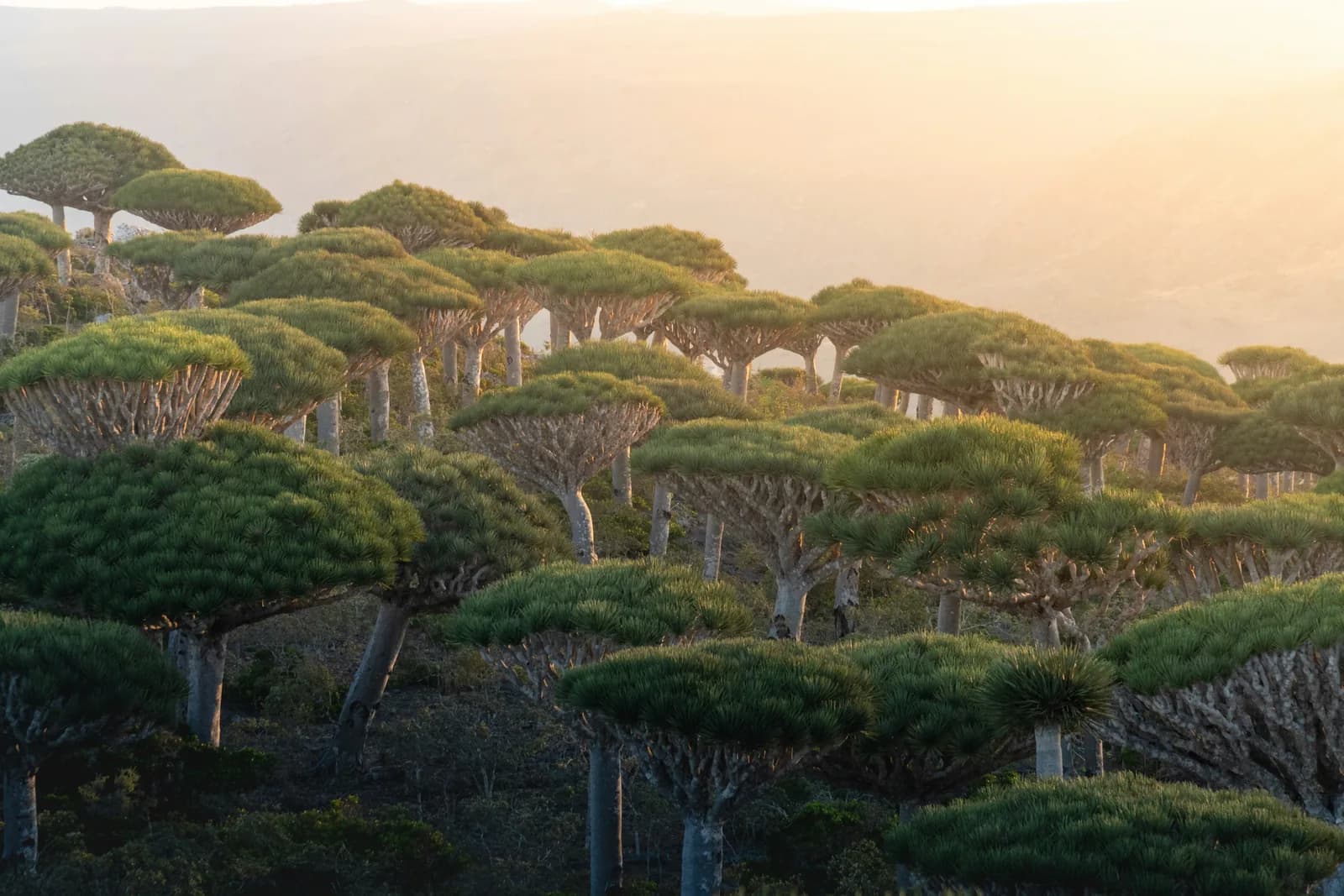
Nothing prepares you for the scale of it. Photographs of the dragon's blood tree flatten what is actually happening on the Diksam plateau, where thousands of them stand in loose ranks across the limestone, each one a dense green disc balanced on a bare trunk. They look designed. They are not, and the shape is the whole point.
What the shape is for
Dracaena cinnabari belongs to the asparagus family, which is a genuinely strange fact to hold in your head while standing under one. Its trunk grows without branching until the tree flowers, at which point the crown divides in two. It flowers again, and each branch divides again. Repeat that over centuries and you get the crown you see: hundreds of terminal branches, packed so tightly that the canopy reads as a solid surface.
That canopy does two jobs on an island with very little rainfall. It intercepts the monsoon mist that rolls across the plateau, condensing it onto waxy leaves that channel water down the branches to the trunk and into the root zone. And it shades its own roots from a sun that would otherwise cook the thin soil dry. The tree is, in effect, its own irrigation system and its own parasol.
Look underneath one and you will usually find a small circle of greener, denser vegetation than the surrounding ground. That is the tree's microclimate, and it shelters other endemic plants that could not survive the open plateau.
Where to actually see them
Firmihin is the answer for most visitors. It sits on the Diksam plateau in the island's interior and holds the densest surviving stand of mature trees anywhere. Almost every operator routes through it, usually with a night camped nearby, and the reason to stay rather than pass through is the light: the crowns read as flat silhouettes at midday and become extraordinary at dawn and dusk.
Beyond Firmihin, the trees are scattered rather than massed. Homhil in the north-east combines them with bottle trees and frankincense on a plateau above a natural pool. Individual specimens stand along the road up to the Diksam plateau, and the interior tracks pass groves of a few dozen at a time. If you want density, go to Firmihin. If you want a single tree against sky, the plateau edges are better.
The resin
Cut the bark and the tree bleeds. The sap oxidises from clear to a deep red within minutes, and hardens into brittle crimson beads that can be scraped off.
This is dragon's blood, and it is why the island appears in classical sources at all. It was traded into the Mediterranean and across the Indian Ocean for well over two thousand years, used as a pigment, a varnish, a cosmetic and a medicine. The resin has been harvested since at least the sixth century BCE, and the earliest firm written record of the trade is the first-century Periplus of the Erythraean Sea. Socotri households still harvest it in small quantities, and you will be offered it in Hadibo and at roadside stops.
The trade is a fraction of what it was, and the resin you buy is a souvenir rather than a commodity. Buying a small amount supports the households that collect it. Cutting a tree yourself does not, and should not need saying.
The part most guides leave out
The forests are not healthy, and saying otherwise would be dishonest.
The trees you photograph at Firmihin are old. The problem is what is not there: young ones. Seedlings germinate, and then goats eat them. Grazing pressure across the plateau is intense enough that regeneration happens mainly in places animals cannot reach, on cliff ledges and inside rock clefts, which is not a distribution that sustains a forest.
Layered on top of that is climate. The island is drying, and the monsoon mist the trees depend on is arriving less reliably. Cyclone Chapala struck on 1-2 November 2015 as a Category 4 system with winds up to 160 kph, the strongest tropical system recorded in the Arabian Sea to that point, and Cyclone Megh followed a week later. They destroyed mature trees outright, and the IUCN's assessments have repeatedly flagged increasing cyclone intensity as a threat that a slow-growing, slow-reproducing species cannot absorb.
The UNESCO and IUCN record on this is public, detailed, and worth reading before you travel. It changes what you are looking at. A stand of dragon's blood trees is not a timeless landscape. It is a population with a demographic problem, photographed at the point where it is still spectacular.
There is conservation work happening. Fenced enclosures that exclude goats do produce surviving seedlings, and community nurseries have been established. Whether that scales to the size of the problem is an open question.
The numbers
The most recent island-wide survey counted 80,134 dragon's blood trees, spread across 20 sub-populations (Sustainability 11(13):3557, 2019). The largest is Firmihin, with 32,195 individuals in that survey; a drone census published in 2023 counted 35,542 living trees there. The smallest sub-population is 15 trees.
The figure that reframes the plateau is a different one. The species occupies roughly 51,963 hectares, but only 230 hectares of that is true dragon's blood forest — under half of one per cent. Three-quarters of the trees stand in habitat the survey classes as degraded.
So Firmihin is not a fragment of some wider forest. It is very close to being the whole of it.
You will also see Firmihin given as about 540 hectares. That figure comes from a gazetteer polygon drawn around the stand, and it is not measuring the same thing as the 230 hectares of true forest: one is the outline of where the trees are, the other is the area dense enough to be classed as forest. Both are in the literature, neither is wrong, and they are not interchangeable.
How old are they
You will hear a thousand years, and that is the figure the conservation literature and National Geographic use for the oldest trees.
It cannot be checked. Dracaena cinnabari has no annual growth rings, so nobody can core a trunk and count. Ages are inferred from the branching pattern, since each fork marks a flowering, and from growth rates measured over a few decades and extrapolated. Treat any specific age you are given on the plateau as an estimate with a wide margin around it.
Why they are not coming back
The mechanism is precise, and it is not the one most visitors assume.
Mature trees are not dying quickly. Adult mortality runs at under one per cent a year. The species is not being logged and it is not being cooked by heat. It is failing to reproduce.
An eight-year seedling study found growth slow under every treatment, found that regularly watered seedlings reached 156 to 446 per cent of the growth of unwatered ones, and reported the line that matters: "continuous goat exclusion was necessary to prevent seedling mortality". Its authors attribute the extinction risk to a lack of natural regeneration, from goat herbivory or climate or both, and conclude that restoration "will require a commitment to active management that will last decades, rather than a short-term approach".
IUCN's 2025 World Heritage Outlook rates overgrazing the most severe terrestrial threat on the island — "Very High, Throughout (>50%)" — and names it a primary factor in the decline of both this tree and the island's frankincense species.
How many goats? Three answers
This is where the published record stops agreeing with itself, and the disagreement is worth seeing rather than smoothing over.
- Goats: about 19,000 in 1966, 220,000 by 1999, and 480,000 — 1.33 per hectare — in a 2022 assessment.
- Livestock of all kinds: about 45,000 in the 1950s, rising to 220,000 by 1999.
- All livestock against people: more than 566,000 animals, for a human population of roughly 44,000 (2014).
The 1950s and 1966 baselines differ by more than double, and "goats" and "all livestock" are not the same denominator, so these cannot be chained into a single trend line. Anyone who quotes you one clean number for this has picked a series. What survives all three is the direction and the order of magnitude: the number of browsing animals on a small island has grown enormously within living memory, and seedlings are what pays for it.
The nursery, and what one tree costs in labour
There is a counter-example, and it is deliberately small.
A community nursery established in 2006 has planted roughly 800 saplings, of which about 600 survive. Goats have eaten around 200 over twenty years. The saplings need watering every day through their first year, and something over a century to reach a height where a goat can no longer reach the growing tip.
That is the real arithmetic of restoring this species: a hundred years per tree, in a place where a fence has to be maintained for all of it. The work is run by a Socotri family, Keabanni and his son Salem Mohammed Salem Abdullah, with Petr Maděra of Mendel University and Kay van Damme of Ghent University and the Friends of Socotra. Most operators will stop there if you ask, usually as a short visit near the end of a trip.
Practical notes
The trees are at altitude, mostly between roughly 300 and 1,500 metres, which means the plateau is cooler and windier than the coast. Bring a layer even if you have spent the day at sea level in shorts.
There is no entrance gate and no ticket at Firmihin in the way you might expect. Access is through your operator, and community fees where they apply are usually inside your package price. Confirm that rather than assume it.
For photography, the crowns are the subject and the light is everything. Midday flattens them completely. Early morning mist on the plateau is the shot most people are after, and it is not guaranteed on any given day.
Do not climb them. It happens, it appears in photographs, and it damages a tree that took centuries to reach that size.
Where this fits in a trip
Firmihin sits naturally in the middle of the standard circuit, usually paired with the canyons below the plateau. If the endemic flora is your main reason for coming rather than a stop along the way, say so when you enquire: the difference between seeing the trees and spending real time in them is a scheduling decision, and it is easier to make before the itinerary is fixed than after.
Trips built around the flowering window sit in our expedition packages, and the wider endemic story, including the bottle trees and the frankincense species, runs through endemic flora.
Three things decide whether you see them at their best. The flowering window is February to March, which is also the most comfortable and the busiest part of the season — the month-by-month picture is in when to visit Socotra. Getting there means one route, filed twice a week at best, booked through a licensed operator rather than online: how to get to Socotra. And a week on the island runs roughly $2,500 to $4,500 all in with flights, broken down in what Socotra actually costs. If the travel advisories are what is stopping you, we have set out what they say and what they mean.
What grows alongside it
The dragon's blood tree gets the photographs, but it is one endemic among many, and the plateau makes more sense once you can name its neighbours.
The bottle tree, Adenium obesum socotranum, is the other one you cannot miss: a swollen grey trunk like a stack of melted candles, topped with bright pink flowers in the flowering months and often growing straight out of bare rock. It stores water in that trunk, which is why it can hold a cliff face where nothing else will.
Frankincense grows here as several species found nowhere else, Boswellia trees clinging to slopes at angles that look like mistakes. Socotra's frankincense was traded alongside its resin, and some of those species are now down to very small numbers of individuals.
Then there is the cucumber tree, Dendrosicyos socotranus, the only species in the cucumber family that grows as a tree. It looks like something drawn by a child who was told what a tree was but had never seen one.
Roughly a third of Socotra's plant species grow wild nowhere else. That figure is the reason the archipelago is a UNESCO World Heritage site, and it is worth carrying around the plateau with you: most of what is at your feet is as restricted in range as the tree overhead.
A note on the name
You will see the island's tree called a dragon tree, and you will find dragon trees in the Canary Islands, in Morocco and elsewhere around the region. They are relatives, not the same thing. Dracaena cinnabari is Socotra's alone.
The name comes from the resin rather than the tree. Medieval and classical sources describe dragon's blood as the congealed blood of a dragon and an elephant killed in combat, which is a better story than tree sap and did no harm at all to the price.
Chat with a real person — free
Seif and the team reply on WhatsApp — trip questions, custom plans and booking help.
Ask Seif on WhatsAppKeep reading
Birding on Socotra: The 11 Endemic Birds and Where to See Them
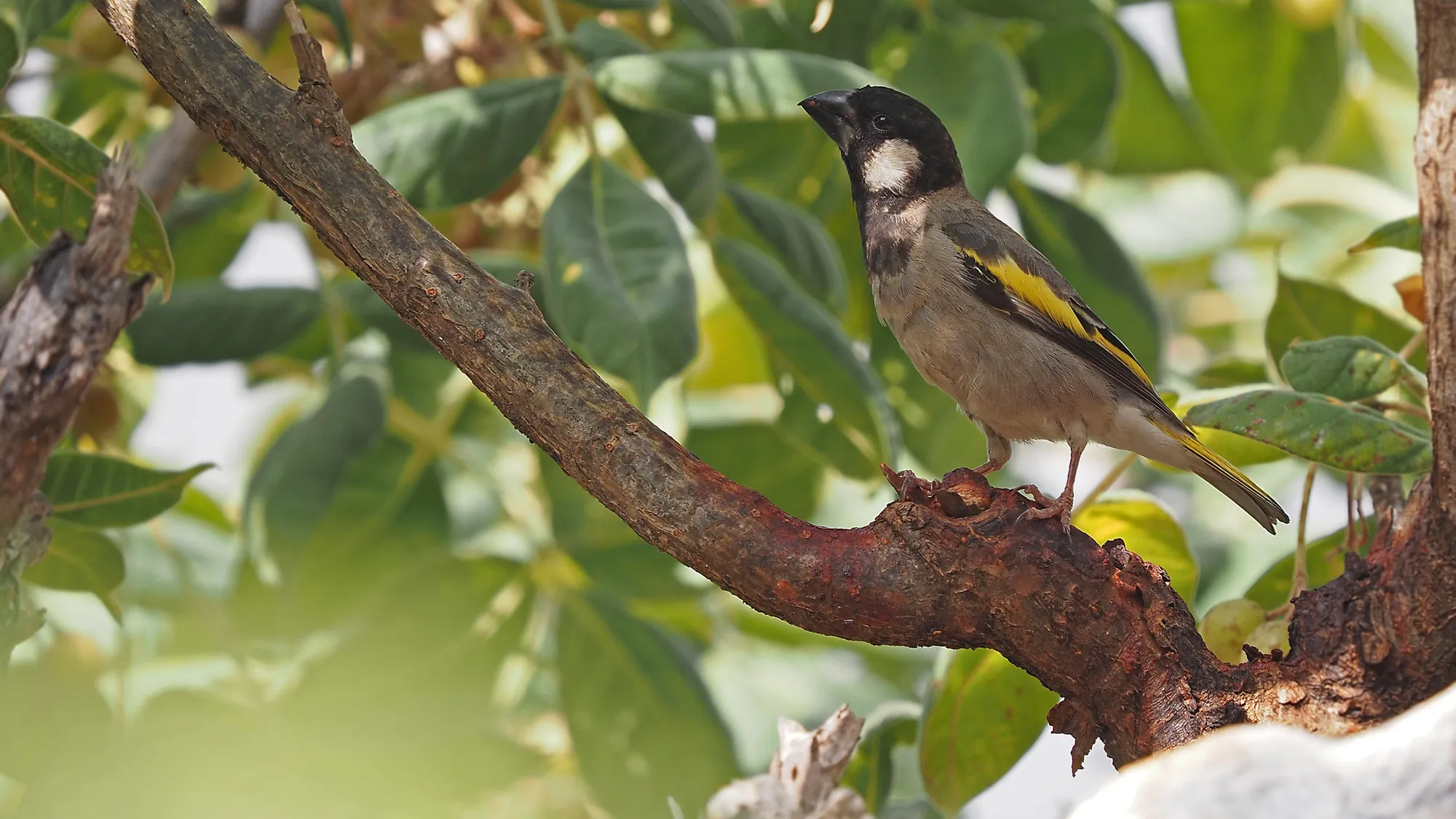
Eleven bird species live only on the Socotra archipelago. Where to look for them, the one standard trips cannot reach, and how each is doing on the Red List.
By TiS Authors8 min read
How to Get to Socotra in 2026–27: The Jeddah Flight, and Every Other Route
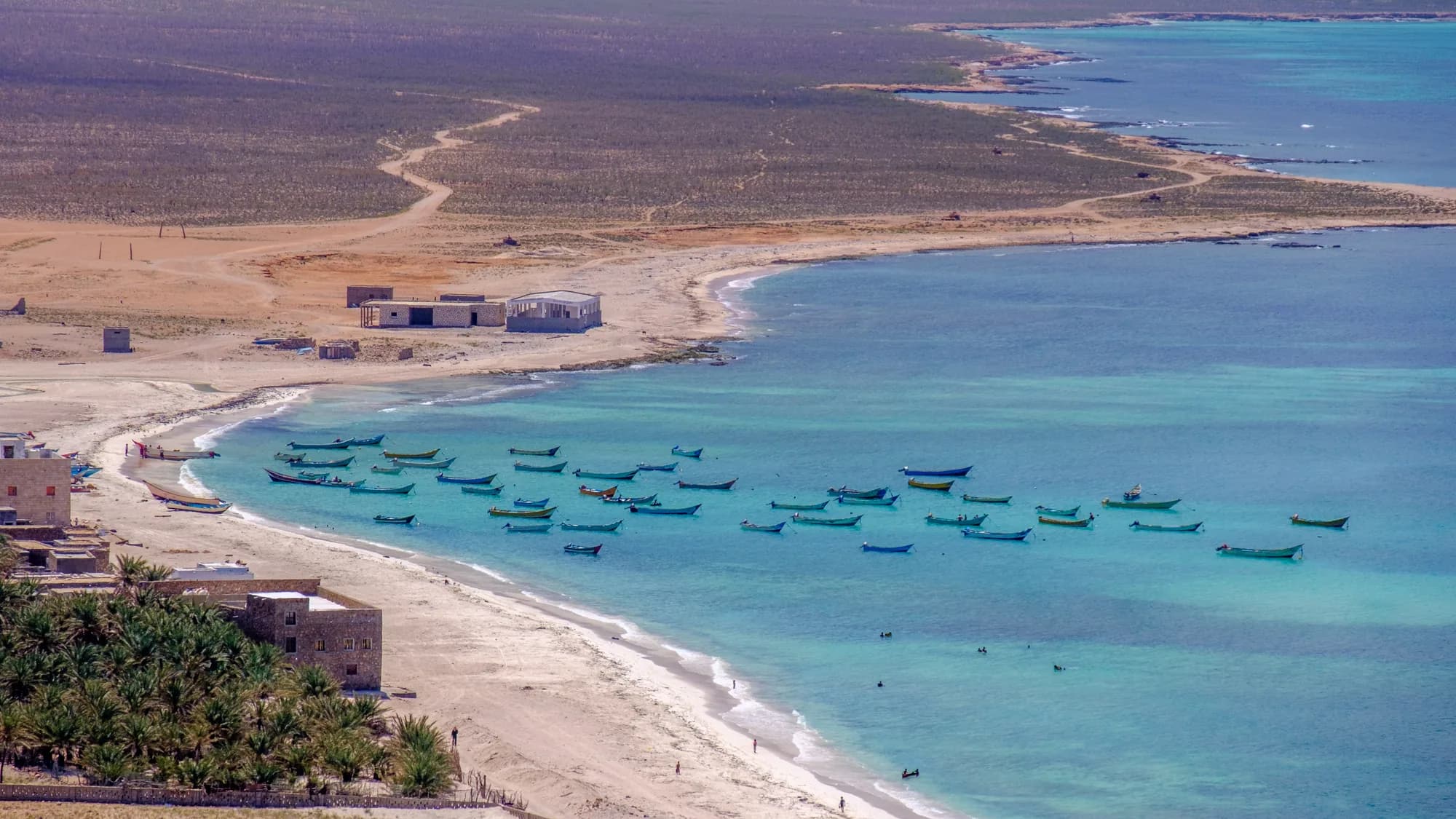
One direct international flight reaches Socotra, and even its timetable is disputed. The Jeddah flight as filed, what Yemenia has and has not confirmed, what it costs, and what became of the other routes.
By TiS Authors9 min read
Socotra Permit and Entry, 2026–27: It Is Not a Yemen Visa
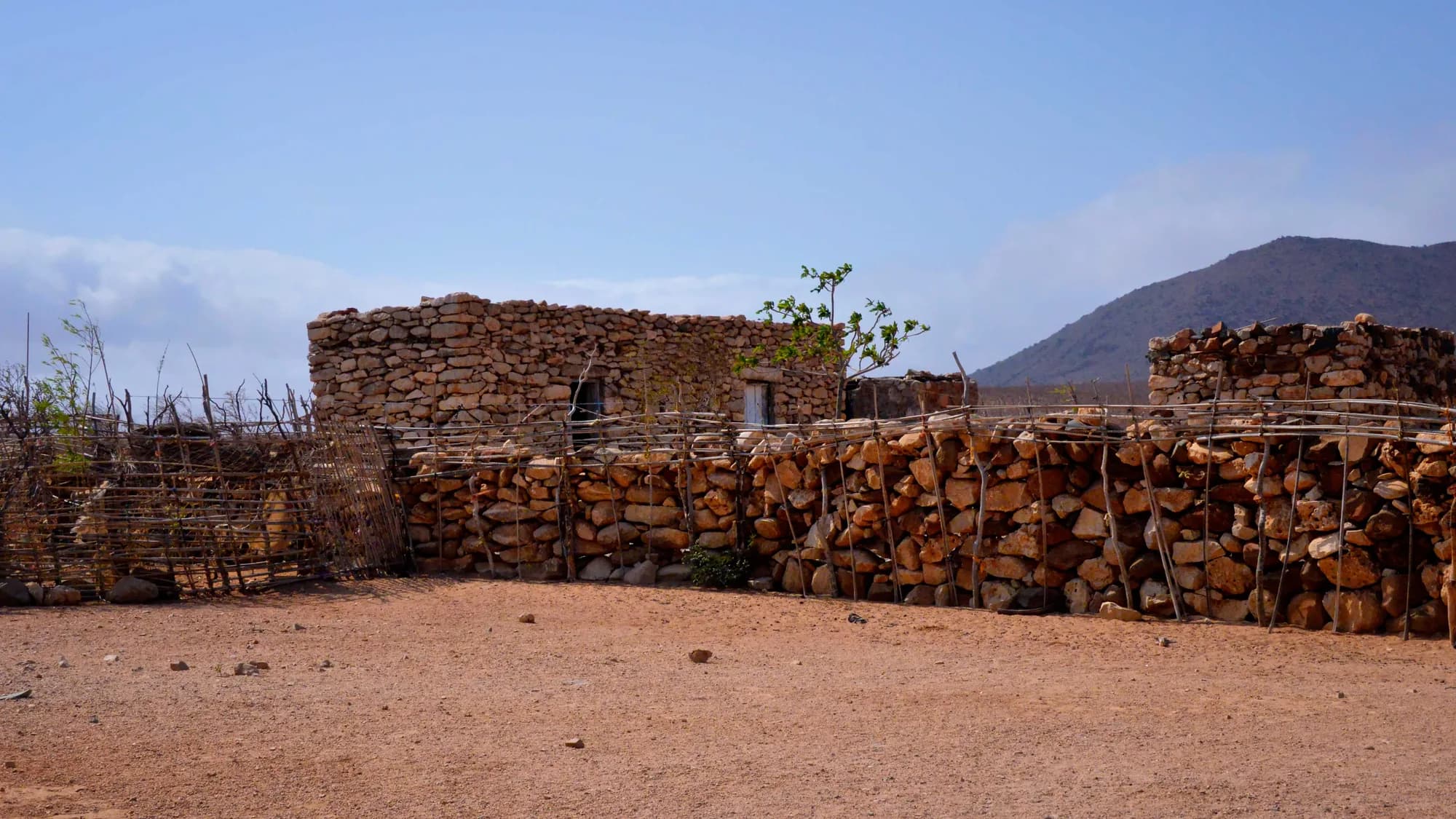
Every Socotra trip runs on a permit your operator arranges, while governments describe a different document altogether. What the permit is, what it costs, who issues it, and the distinction almost nobody writes down.
By TiS Authors8 min read