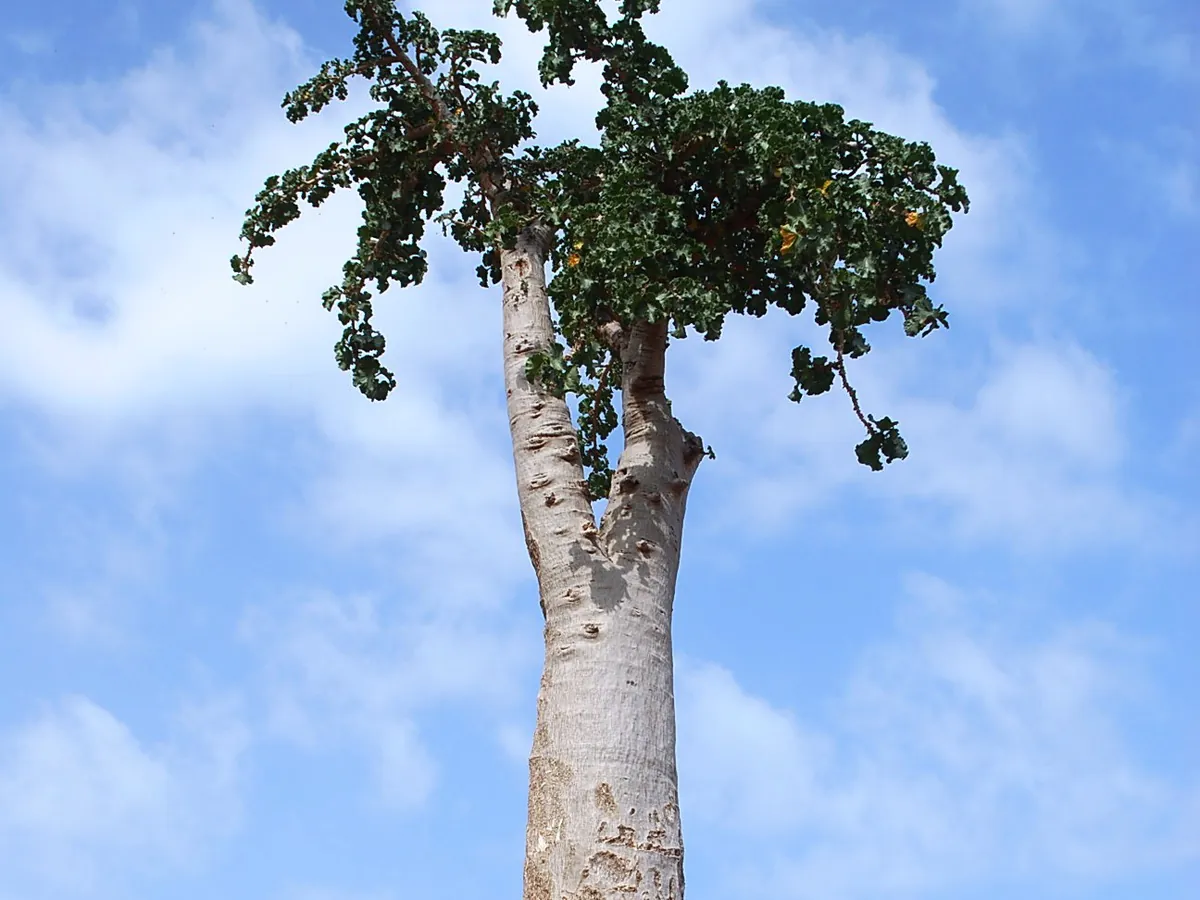
Of all Socotra's endemics, this is the one that looks most like a mistake. A fat, pale trunk with almost no taper, a few thick branches at the top, a scatter of crinkled leaves, small yellow flowers — and it belongs to the family of the cucumber in your fridge.
Every other member of the Cucurbitaceae is a vine or a herb. Dendrosicyos socotranus is the only one anywhere that grows into a tree, and it does it only here.
The only tree in its family
Botanists describe it as the sole arborescent member of the cucumber family, which is the formal way of saying that no other cucumber relative on earth has done this.
The trunk is the giveaway. It is thick, smooth and pale, it barely narrows as it rises, and it is built to hold water rather than to hold weight. Branches come late and few, and the crown is thin enough that the tree throws almost no shade.
How many there are
A survey published in 2020 counted 163 live trees, excluding seedlings, across all 24 locations it investigated, covering 96 square kilometres. From that sample the researchers estimated that more than 6,400 cucumber trees grow on Socotra.
That is a small number for a whole species, but the same survey found something the dragon's blood tree cannot claim: natural regeneration in 77 per cent of the locations that held adult trees, with 16 per cent of individual trees regenerating.
Set those two species side by side and you get the clearest picture of what is actually wrong on the island. The dragon's blood tree is far more numerous and is failing to reproduce. The cucumber tree is rarer and, in most places surveyed, is still managing it.
Where it grows
The 2020 survey puts it predominantly in high shrubland with succulents, and in wadi environments.
In practice that means you see it one tree at a time, standing clear of whatever else is growing, rather than in a grove. There is no cucumber-tree equivalent of Firmihin to visit.
Telling the fat trunks apart
Socotra has three plants that store water in a swollen base, and photographs of them are mislabelled constantly.
The [bottle tree](/wildlife/bottle-tree), Adenium obesum subsp. socotranum, is grey-pink and squat, and carries pink trumpet flowers in February and March.
The bottle fig, Dorstenia gigas, grows out of cliffs and rock faces and carries small fig-like heads.
The cucumber tree is the tallest and palest of the three, with a trunk that stays wide most of the way up and a sparse crown of crinkled, roughly heart-shaped leaves.
A note on the name
You will see the species written both as Dendrosicyos socotranus and as Dendrosicyos socotrana, including on tour operators' botany pages. The 2020 paper uses socotranus, and that is the spelling used here.
If you are searching for it, both spellings will find the same tree.
Seeing it on a trip
There is no independent travel on Socotra, so every sighting happens on an operator-led trip. No itinerary lists the cucumber tree as a stop, because it does not work that way — it appears beside the track, and whether you get a photograph depends on whether your driver is willing to stop.
Say at the enquiry stage that the endemic plants are the reason you are coming. It changes how the days get built.