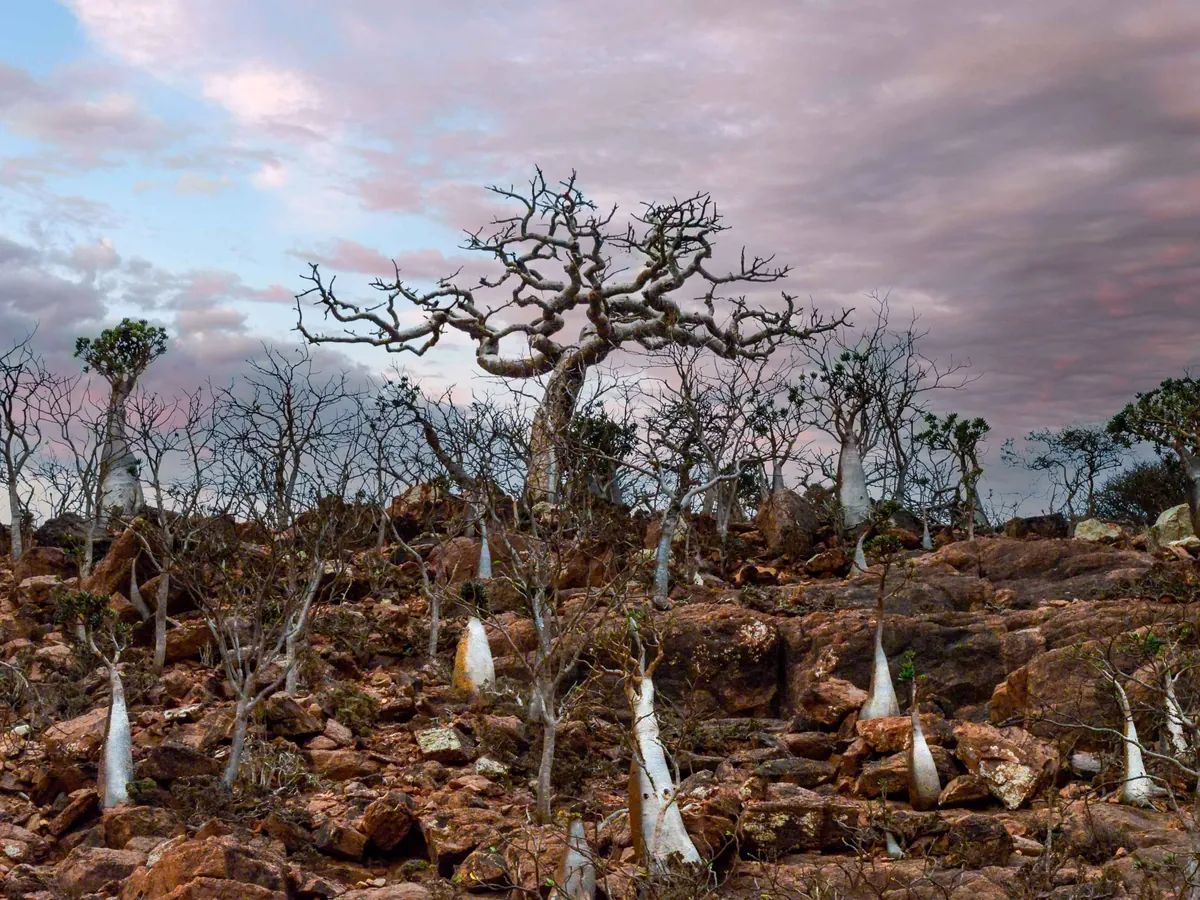
Frankincense is the one Socotran plant most visitors think they already understand, and the understanding is usually backwards.
The island does hold nearly half the world's frankincense species. It does not supply the world's frankincense, and it has not for a very long time. Both of those things are true at once, and the second is the more interesting one.
Eleven species, and why the number matters
There are 24 Boswellia species worldwide. Eleven of them grow only on the Socotra archipelago — a concentration found nowhere else.
They do not look like one tree with variations. Some are squat and multi-stemmed, some grow almost flat against rock, some reach out sideways off a cliff at an angle that looks like a mistake. What they share is smooth, papery bark and a habit of growing where nothing else bothers.
The framing most articles get backwards
The great incense trade ran out of Dhofar and the Hadhramawt on the Arabian mainland, not out of Socotra, and today's commercial frankincense still does. Socotra's Boswellia trees are not the main source of the resin sold as frankincense.
The island's frankincense significance is botanical: it is where the genus is most diverse, not where the trade came from. Classical sources do tie the island to that world — the first-century Periplus records that the island "is subject to the King of the Frankincense Country" — but that is a statement about who ruled it, not about what it exported.
What the 2024 assessment found
A Red List assessment completed in 2024 placed every one of the eleven endemics in a threatened category: seven Endangered and four Critically Endangered. The four Critically Endangered are Boswellia nana, B. samhaensis, B. scopulorum and the taxon listed as B. "hesperia".
You will also see it reported that nine species are threatened. Both numbers are in circulation and they are not contradictory: the nine are the species whose category changed in the 2024 round, while the full list assigns Endangered or Critically Endangered status to all eleven.
One place, counted twice, sixty years apart
The clearest measurement on the island comes from Homhil, where a single species was counted at 1,187 trees in 1956 and 264 in 2017.
That is not a projection or a model. It is the same population, counted twice, six decades apart.
Why they are failing
The same pressure that is stopping the dragon's blood tree from reproducing applies here. IUCN's 2025 World Heritage Outlook rates overgrazing the most severe terrestrial threat on Socotra, "Very High, Throughout (>50%)", and names it a primary factor in the population decline of both Dracaena and Boswellia.
Seedlings are browsed before they can establish. Mature trees hold on, and the age structure gets steadily older.
Where to see them
[Homhil](/attractions/homhil) is the reliable one, and it is the site with the counted decline. Frankincense grows there alongside bottle trees and dragon's blood trees on the same slope, which is the photograph most people come back with.
Individual trees appear elsewhere on rocky ground and cliff edges across the island. As with most of the endemic flora, you see them from the track rather than at a marked site.
The resin, and what you will actually be offered
Resin is still tapped in small quantities on Socotra, in nothing like the volumes the mainland produces.
If you are offered red resin in Hadibo or at a roadside stop, that is dragon's blood rather than frankincense — a different tree, a different resin, and the subject of [its own guide](/guides/dragon-blood-tree-guide). Do not cut a tree yourself for either.