Socotra's UNESCO Listing: What It Protects, and What Went Wrong
Socotra was inscribed on the UNESCO World Heritage List in 2008 under criterion (x) alone — biodiversity, nothing else. In October 2025 IUCN rated the site "Significant Concern", with its values in High Concern and deteriorating. In July 2026 the World Heritage Committee again stopped short of the List of World Heritage in Danger, but asked Yemen to immediately halt all unapproved projects and to enforce a moratorium on unauthorised construction and land allocations. It said a new monitoring mission by 2030 would let it assess progress.
Almost every article about Socotra mentions the UNESCO listing in its opening paragraph and then never returns to it. The listing gets used as decoration — proof the island is special, a reason to book. It is actually a legal instrument with conditions attached, and behind it sits a seventeen-year paper trail of what Yemen promised, what inspectors asked for, and what they found when they finally got to the island.
That paper trail is public. It is also, as far as we can tell, the single least-reported thing about Socotra. This page is a summary of it, with the disagreements left in rather than smoothed over.
What was inscribed, and under which rule
The property covers 410,460 hectares — a terrestrial core of 277,512 ha and a marine core of 132,948 ha — surrounded by a buffer zone of 1,740,958 ha, most of it sea. The inscribed site stretches 250 km and takes in four islands and two rocky islets, so Abd al-Kuri, Samha and Darsa are inside the listing even though no standard tour goes near them.
It was inscribed under criterion (x) and only criterion (x): in-situ conservation of biological diversity. Socotra is a purely natural listing. It is not a cultural site and not a mixed one.
That absence is worth sitting with. The Soqotri language — a Modern South Arabian language, not a dialect of Arabic, and classified by UNESCO as severely endangered — is not protected by the listing. Neither is the oral poetry, nor the rangeland-management vocabulary that encodes centuries of knowledge about how to graze this landscape without wrecking it. The World Heritage designation protects the plants and the reptiles. It does not protect the language that names them.
Here is the official framing, verbatim, from IUCN's 2008 technical evaluation:
"Socotra is globally important for biodiversity conservation because of its exceptionally rich and distinct flora and fauna. 37% of Socotra's plant species, 90% of its reptile species and 95% of its land snail species do not occur anywhere else in the world."
Those three numbers are the ones to use, and they should be kept apart. Socotra has 825 recorded plant species of which 307 — about 37% — are found nowhere else; reptiles run at roughly 90%; land snails at about 95%; insects at roughly 42%. You will see all of this collapsed into a single claim that "a third of Socotra's species are endemic," or half, depending on who is writing. There is no defensible blended figure, and the plant number is the one that gets misapplied to everything else.
The conditions attached on day one
Inscription was not unconditional. IUCN recommended it while attaching four implementation priorities: better management planning for roading, grazing and invasive species; an independent management authority with sustained resources and real enforcement capacity; complementary management of the buffer zones; and a sustainable financing strategy. IUCN asked for a follow-up mission in 2012.
Yemen responded with Cabinet Decrees 45–49 on 12 February 2008. IUCN also noted at the time that conservation financing was 80% external and 20% Yemeni government, which it called "not adequate for long term conservation management."
What the first inspection found
The 2012 mission ran 4–14 November and concluded that "very little has been done since inscription to ensure the long term effective management."
The detail is bleak in a very specific way. The Environment Protection Authority had lost around 75% of its working staff after the Socotra Conservation and Development Programme ended in 2008. Its annual budget for 2012 was approximately USD 5,000, and undisbursed. Its building had been "dysfunctional for quite a while"; the electricity was switched on for the first time in two years when a new director arrived.
Roading, the mission said, was "the most critical factor influencing the World Heritage status of Socotra," built "merely on engineering and security related perspectives with almost total absence of proper environmental and socio-economic criteria." A local leader told the mission: "Roads have their positives, but you need not be an expert to see what destruction they have done to our island."
The mission also recorded a line that explains a great deal of what followed: "Many of the stakeholders met were not aware of what it means to be a World Heritage site; they were not introduced to the implication of such an inscription."
Seventeen years of the same four requests
Read the World Heritage Committee's decisions in sequence and a pattern appears immediately. Between 2015 and 2025 the Committee asked eleven separate times for a monitoring mission, four times for an independent management authority, repeatedly for the Conservation Zoning Plan to be finalised, and once for a map of everything built inside the property since inscription.
It got the mission, in May 2025. It has not got the authority or the finalised zoning plan. The map is a stranger story. Yemen did send one — two image pages at the back of its 2022 report — and in 2023 UNESCO and IUCN said the maps were appreciated but that the exact nature of the developments and their potential impact remained unclear. The Committee's next decision repeated three of its four 2021 requests and quietly dropped the fourth, the map, and no decision since has asked for it again. The 2025 mission did request a development map in its terms of reference; its report gives a count instead: at least 86 illegal or unauthorised land encroachments and construction projects.
Twice in the decade — in 2015 and again in 2024 — the Committee formally regretted that Yemen had not submitted its state of conservation report at all. Where governance stands now, on the 2025 mission's own account:
- No archipelago-wide management plan has been adopted since 2008. The 2003–2008 plan expired seventeen years ago and was never replaced.
- The Conservation Zoning Plan still dates from a Presidential Decree of 2000. Its revision "is not yet finalized or legally approved," property and buffer-zone boundaries "are not demarcated or well understood locally," and its provisions "are frequently violated without consequence."
- The independent management authority IUCN asked for in 2008 has never been created.
- The environmental impact assessment regime exists but is not enforced. Approved in September 2021, operational that December — and the 2025 mission found major infrastructure proceeding without assessments despite the legal requirement.
- EPA's Hadibu office was occupied from 2017 to 2024. Marine enforcement in 2022 was staffed by, in the State Party's own words, "one-two people full staff."
Context matters here and the 2026 report names it plainly: prolonged instability, severe economic crisis and ongoing conflict, producing limited national funds and weakened institutions. This is a chronically under-resourced authority, not a lazy one.
Forty-five metres to one hundred and thirty-five
The clearest single item on the record is the port, because it is a promise and a measurement.
In 2016 Yemen told the Committee that rehabilitation of the seaport would be limited to restoring it to its previous condition, with no extensions. Decision 41 COM 7B.23 in 2017 recalls that commitment word for word.
The original 1996 pier was 45 m long and 5 m deep. It is now 135 m long and 6 m deep. The 2025 mission states this exceeds the 2016 commitment. A second pier and further port facilities are under construction without assessment or approval, bordering a marine core zone — raising, among other things, biosecurity risk on an island where 135 introduced species are already recorded and quarantine capacity, in IUCN's words, is "currently not in place yet."
Separately, the tanker Gulf Dove has sat grounded at Delisha Nature Sanctuary since 2019 and spilled oil in January 2023. As of the 2024 Committee decision, no impact assessment had been carried out.
 Hardscarf · CC BY-SA 4.0
What the 2025 mission found at places on your itinerary
This is the part that connects the paperwork to a trip. Every site below appears on standard eight-day routes.
- Firmihin — fire incidents linked to unregulated tourism, and off-road driving as visitor numbers rise.
- Diksam and the Shibehon Plateau — a large walled tract of Dracaena woodland enclosing 50–100 mature trees behind a private road, an enclosure that triggered tribal disputes; plus major asphalt road construction with no impact assessments.
- Detwah, a Ramsar wetland — traditional low-impact palm shelters replaced by permanent buildings, and vehicles driving into the site.
- Delisha — illegal land acquisition over more than 90% of the coastline, an asphalt road built without assessment, and a large hotel complex plus agriculture projects inside a nature sanctuary without authorisation.
- Hoq Cave — a newly built rocky staircase constructed without prior impact assessment or formal EPA oversight.
- Erisel — a new tourism camp contravening the coastal construction ban.
Island-wide, the mission counted at least 86 illegal or unauthorised land encroachments in a single week of fieldwork, found more than 70% of coastal land on the eastern seaboard carrying reservations and walling, and recorded built-up area growing from 0.49 km² in 1985 to 23.0 km² in 2024 — roughly a forty-seven-fold increase, with Hadibu about a third of the total. IUCN puts road construction at "more than 900 km since 2001," against a network measured at 426.5 km in 2012.
The Danger List question
Socotra is not on the List of World Heritage in Danger. The 2025 mission declined to recommend it "at this time," on the reasoning that the property "continues to retain exceptional biodiversity for which [it was] inscribed" and that "most identified threats [are] largely reversible if addressed promptly."
The World Heritage Committee followed that advice at its July 2026 session. Its decision does not recommend Danger listing, but it records that key terrestrial and marine ecosystems are deteriorating, and says a new monitoring mission by 2030 would allow it to assess progress — including whether the property meets the conditions for the Danger List if its state of conservation does not substantially improve. Back in 2012, IUCN had already said that restarting road construction inside core biodiversity areas "would therefore form a clear case for inscription of the property on the List of World Heritage in Danger."
What UNESCO asked Yemen to do in July 2026
The same decision lists eight priority actions. Three bear directly on what a visitor sees: immediately halt all unapproved projects and assess the ones already built without an impact assessment; enforce a moratorium on unauthorised construction, land allocations and the building of walls inside the property, and reverse unlawful land allocations, particularly in sensitive coastal and plateau areas; and set up island-wide waste management, starting with the towns.
The rest ask for a legally approved management plan and zoning plan, working biosecurity and quarantine controls, habitat restoration with grazing, fuelwood collection and fisheries regulated to the island's ecological carrying capacity, cyclone and climate preparedness, a stronger Environment Protection Authority with a permanent presence where pressure is highest, and for local communities to benefit fairly from conservation and tourism. Yemen's next report is due by 1 December 2027.
What this changes about visiting
Not much, and that is the honest answer. None of the above is a reason to cancel a trip, and the island's own institutions are clear that tourism is not the largest pressure on the site — grazing, unregulated construction and invasive species all rank higher.
What it does change is what you can reasonably expect. There are no visitor limits anywhere on Socotra, no carrying-capacity assessment has been completed, and the zoning that theoretically governs where camps may be pitched dates from 2000 and is not enforced. The practical regulation of your visit is your operator's own behaviour, and nothing else. That is worth knowing before you choose one — see what actually helps on the ground, and how the booking process works in our guide to booking Socotra.
If you want the natural-history side of the same story rather than the institutional one, start with the dragon's blood tree, which is where most of the conservation argument eventually lands.
Chat with a real person — free
Seif and the team reply on WhatsApp — trip questions, custom plans and booking help.
Ask Seif on WhatsAppCommon questions
Is Socotra a UNESCO World Heritage Site?
Yes. The Socotra Archipelago was inscribed on the World Heritage List in 2008. The property covers 410,460 hectares — a terrestrial core of 277,512 ha and a marine core of 132,948 ha — with a buffer zone of 1,740,958 ha, and includes all four islands plus two rocky islets, not just the main island.
Why is Socotra listed as a natural site and not a cultural one?
It was inscribed under criterion (x) alone, which covers in-situ conservation of biological diversity. There is no cultural criterion attached, so the listing protects the flora, fauna and habitats but not the Soqotri language, the oral poetry tradition or the traditional rangeland-management knowledge — all of which are separately documented as endangered.
Is Socotra on the UNESCO Danger List?
No. The joint UNESCO/IUCN monitoring mission of May 2025 advised against Danger listing “at this time,” because the biodiversity the site was inscribed for is still present and most threats are “largely reversible if addressed promptly.” The World Heritage Committee followed that advice in July 2026, while recording that key ecosystems are deteriorating and saying a new monitoring mission by 2030 would assess whether the site then meets the conditions for the Danger List.
What did the 2025 UNESCO mission actually find?
It ran 6–13 May 2025 and counted at least 86 illegal or unauthorised land encroachments in one week. It recorded built-up area growing from 0.49 km² in 1985 to 23.0 km² in 2024, more than 70% of eastern coastal land under reservation or walling, unauthorised construction at Delisha and Detwah, a walled enclosure of dragon trees on the Diksam–Shibehon plateau, and a staircase built at Hoq Cave without impact assessment.
What percentage of Socotra's species are endemic?
It depends entirely on the group, and there is no single figure. About 37% of plant species (307 of 825) are endemic; reptiles run at roughly 90%; land snails at about 95%; insects at roughly 42%. The widely repeated claim that “a third of Socotra's species” are endemic misapplies the plant figure to everything else.
Does the UNESCO listing limit how many tourists can visit Socotra?
No. There are no visitor limits anywhere on the archipelago and no completed carrying-capacity assessment. UNESCO asked Yemen for one as early as 2013, and Yemen's own 2022 report to UNESCO still stated that a comprehensive carrying-capacity assessment is needed. In practice the only constraint on visitor numbers is the number of flight seats.
What happened with the Socotra port and UNESCO?
Yemen told the World Heritage Committee in 2016 that seaport rehabilitation would be limited to restoring the previous condition with no extensions, and the Committee recalled that commitment verbatim in 2017. The original 1996 pier was 45 m long and 5 m deep; it is now 135 m long and 6 m deep, which the 2025 mission states exceeds the commitment. A second pier is under construction without assessment or approval beside a marine core zone.
Does visiting Socotra damage the World Heritage site?
Tourism is not ranked as the largest pressure — overgrazing, unregulated construction and invasive species all rate higher in IUCN's 2025 assessment. But tourism-linked damage is documented specifically at Firmihin, where fire incidents and off-road driving are recorded, and at Detwah, where camps have been built inside a Ramsar wetland. Visitor numbers have grown roughly thirty-fold since 2000 on an island with no waste-treatment or recycling infrastructure.
What did UNESCO ask Yemen to do about Socotra in 2026?
In July 2026 the World Heritage Committee asked Yemen to immediately halt all unapproved projects, enforce a moratorium on unauthorised construction, land allocations and wall-building inside the property, reverse unlawful land allocations, finalise a legally approved management plan and zoning plan, put biosecurity and quarantine controls in place, and build island-wide waste management. It asked for an updated report by 1 December 2027.
Keep reading
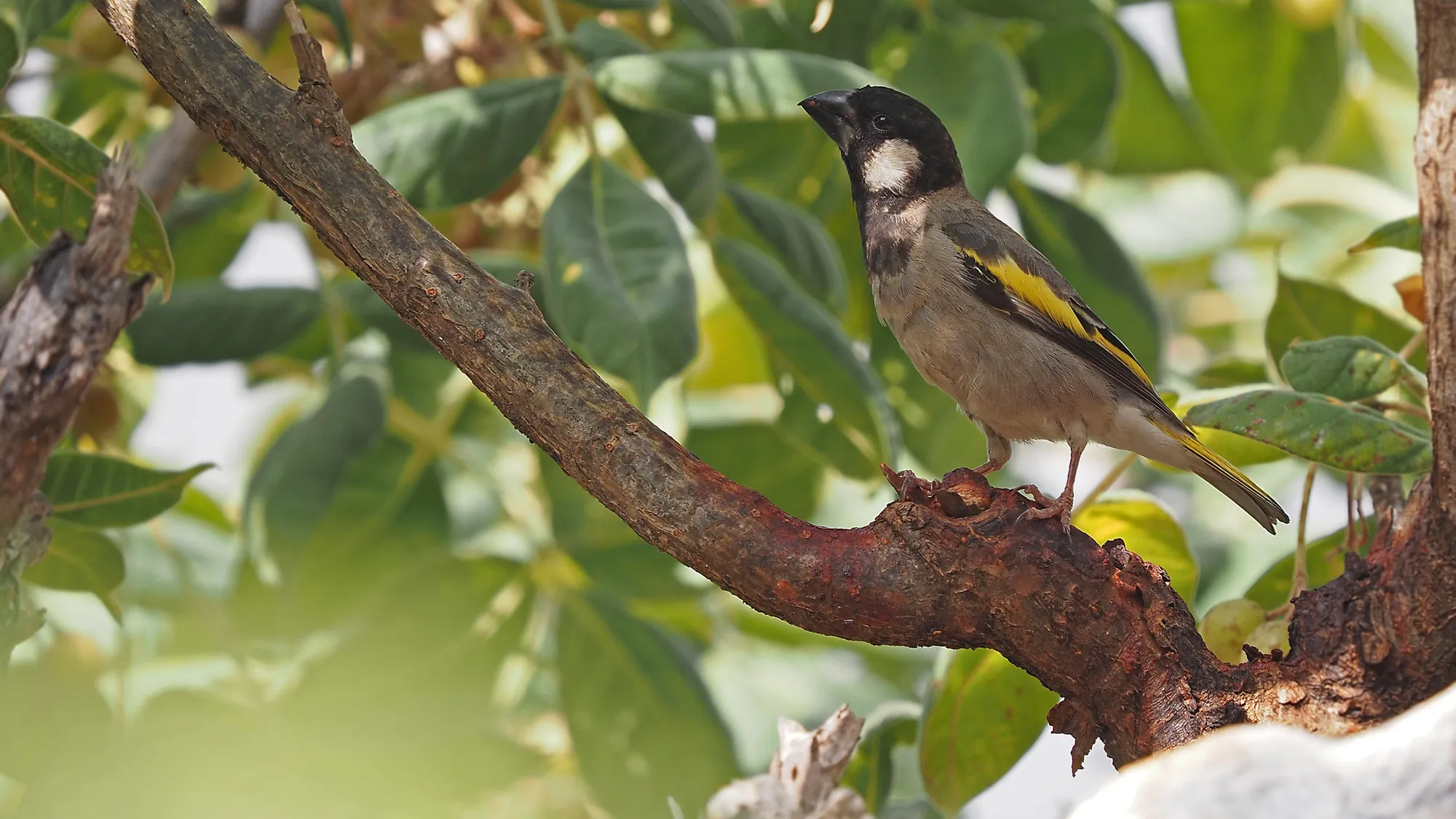
Birding on Socotra: The 11 Endemic Birds and Where to See Them
Eleven bird species live only on the Socotra archipelago. Where to look for them, the one standard trips cannot reach, and how each is doing on the Red List.
By TiS Authors8 min read
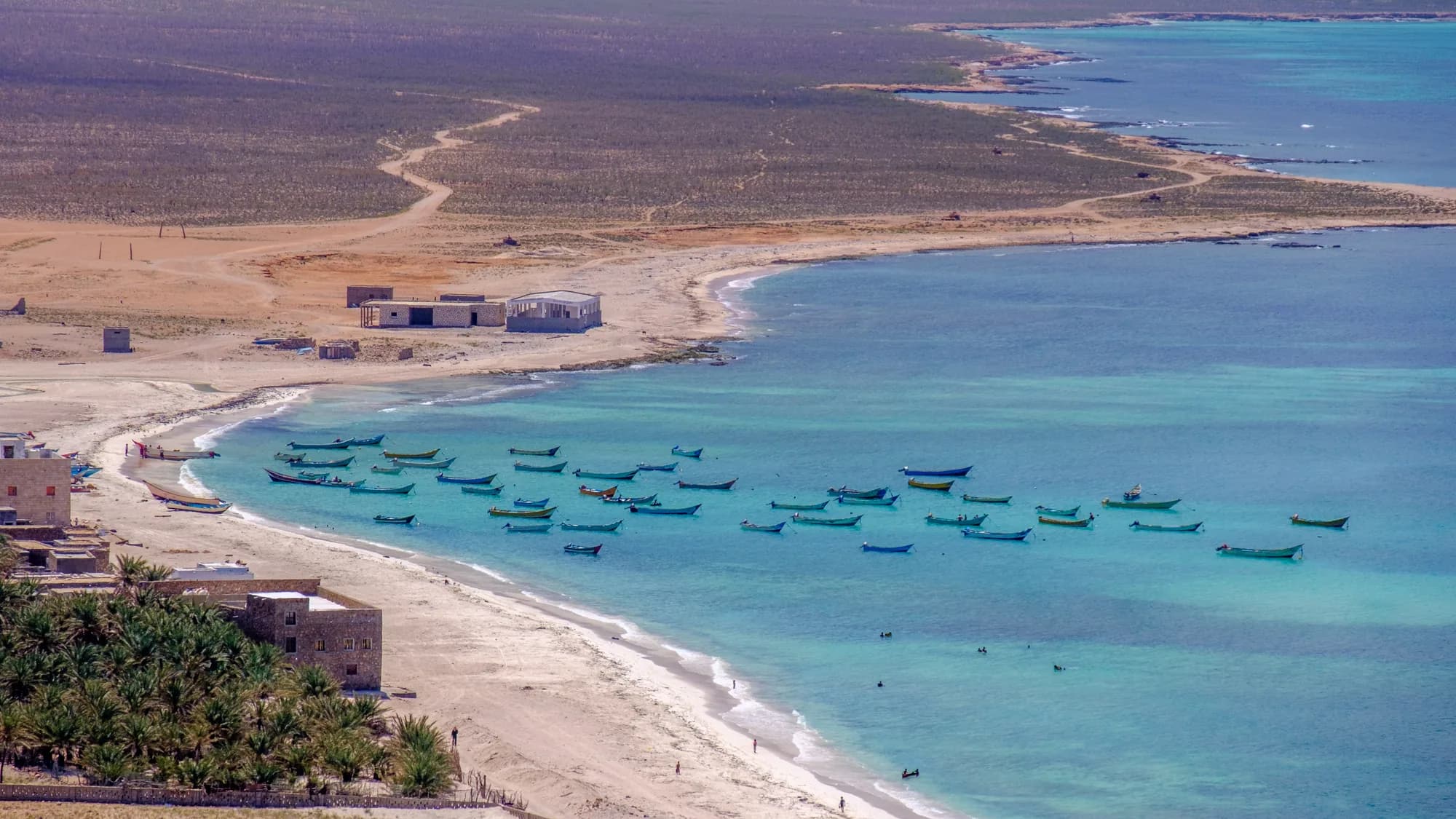
How to Get to Socotra in 2026–27: The Jeddah Flight, and Every Other Route
One direct international flight reaches Socotra, and even its timetable is disputed. The Jeddah flight as filed, what Yemenia has and has not confirmed, what it costs, and what became of the other routes.
By TiS Authors9 min read
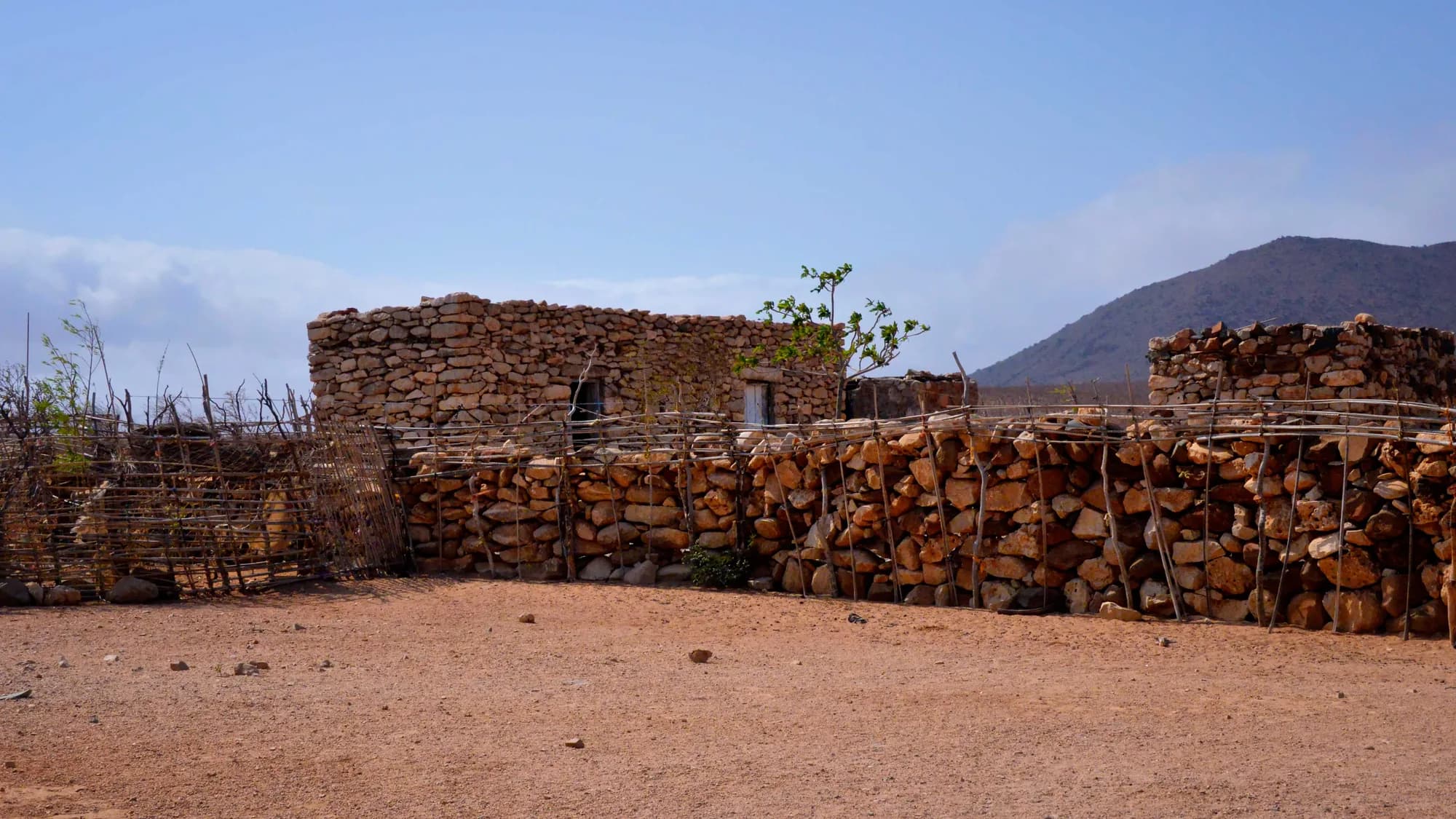
Socotra Permit and Entry, 2026–27: It Is Not a Yemen Visa
Every Socotra trip runs on a permit your operator arranges, while governments describe a different document altogether. What the permit is, what it costs, who issues it, and the distinction almost nobody writes down.
By TiS Authors8 min read